
Objects for January, February and March
Auriga
Distances: Capella 42.8 ly, Almaaz 2000 ly, Saclateni 750 ly, Haedus 240 ly, M36 4000 ly, M37 4500 ly, M38 4000 ly [Karkoschka p30]
“For latitudes north of 44 degrees, Capella is circumpolar. It is a beautiful sight as it glitters low in the north during the long twilights of midsummer.” [Crossen, p69].
The Kids
In the triangle of The Kids, Zeta and Eta, only ¾ degree apart, are a good colour contrast pair for 50mm binoculars, Zeta (Saclateni*) is orange and Eta (Haedus*) is silver-blue [Crossen, p69].
* These star names are obtained from Karkoschka p30
Open Clusters M36, M37 and M38:
“The Milky Way flows through Auriga, and there are also some fine open clusters. With x7, there are three in the same field: M36,37 and 38”. [Moore, Binoculars, p60].

Camelopardalis
Kemble's Cascade 
"Kemble’s Cascade is often described as appearing like a waterfall of stars, pouring into a splash pool represented by NGC 1502" [10].

Canis Major
Canis Major contains “lovely star-fields” [Moore, Binoculars, p66] and offers a… “rich star field for the unaided eye or 7x binoculars” [Crossen, p66]. “The Milky Way touches the (constellations’) eastern border, and fine sweeping is to be had” [Muirden, p114].
Sirius
Distance: 8.6 ly [Karkoschka p64]. "Of a Thousand Colors" "...as many as thirty changes of hue in a second had been observed in it" [Allen, pp127-8]." "Sirius is approaching the Solar System at a speed of 5.5 km/s. In 60,000 years time, it will be at its closest to the Sun, 7.8 light years, at which point it will appear 20% brighter than it is today. After this it will recede from the Sun and in millions of years’ time it will be so faint it won’t be visible to the naked eye" [12].
Mirzam
Distance: 500 ly [Karkoschka p64]. "the Announcer" of Sirius' rising [Allen, pp127-8]. Crossen (p67) suggests we compare the colour of (blue-white) Sirius and (silver-blue) Mirzam, the latter being nearly 12,000 degrees K hotter!
M41 - Open Cluster
Distance: 2300 ly [Karkoschka p64] “M41 is ... 20 light-years in diameter” [Moore, Binoculars, p66]. M41 is an easy binocular object for British observers [Muirden, p114].

Monoceros
Procyon
Distance: 11.5 ly [Karkoschka p70]
Rosette Cluster NGC 2244
Distance: 5000 ly [Karkoschka p70]. "a magnificent binocular cluster, visible to the naked eye as a condensation in the Milky Way” [Muirden, p127]
In binoculars the cluster is easily resolved [Crossen, p73]. “For the binocular observer, the most astonishing thing about the whole Rosette Complex is that the nebula (except for its central hole) is not all that difficult to see. In 10x50s averted vision is barely necessary and the nebula is even visible in 40mm zooms at about 16x… The Rosette Nebula… like the Orion Nebula, a region where star formation is presently occurring” [Crossen, p74] But Crossen goes on to caution that the Rosette Nebula is also “ghostly and tenuous”

Orion
|
Isobel Thrilling from "Lumber" |
"I have never beheld the first indications of the rising of Orion without a peculiar feeling of awakened expectation ..." [Serviss p89]
Distances: Betelgeuse 650 ly, Bellatrix 250 ly, Alnitak 1200 ly, Alnilam 1300 ly, Mintaka 1200 ly, Sigma 1300 ly, Eta 1300 ly, Saiph 650 ly, Rigel 850 ly, M42 1400 ly [Karkoschka pp60 & 62]
Crossen tells us that the stars of the Belt and Sword, as well as Rigel, Kappa, Sigma, Eta, and Lambda Orionis, are members of the Orion OB 1 Association and therefore are physically related (Betelgeuse and Bellatrix in Orion's shoulders are not members). The OB-1 stars have all formed from a huge interstellar cloud of gas and dust that still covers most of the constellation. OB-1 is over 1000 light-years deep, and 700 wide. The Association's nearest bright star is Rigel, and its farthest is Kappa. [Crossen, pp62 & 63]


Orion is an extremely "old" constellation, a basic map of it has been found on a piece of mammoth tusk 32,500 years old [1]. Robert Bauval explains that the Ancient Egyptians knew Orion as "Sah" who represented Osiris. Further he states that the plan of the Great Pyramids of Giza reflects the pattern of the Belt of Orion [2]. Also in neolithic Britain three henges at Thornborough were laid out to emulate Orion's Belt. [6].
Below: Galileo's 1610 telescopic drawing of the Belt and Sword

Betelgeuse - Orion's red supergiant Betelgeuse's naked eye appearance is believed to have reddened noticeably over the last 2000 years [3]. At least part of Betelgeuse's superimposed 400 and 2100 day periods of variablity are due to the presence of a star (named Siwarha) orbiting inside the larger star's atmosphere causing ripples. Siwarha moves in front of Betelgeuse every 2100 days, or six years [4]. In 2019 Betelgeuse's naked eye brightness dimmed due to the star casting off a large portion of its atmosphere which formed an obscuring dust cloud [5]. Betelgeuse is probably the largest star you can see with the naked Eye - "It is believed to be at least the size of the orbit of Mars and at maximum diameter may possibly equal the orbit of Jupiter" [Burnham, Vol 2, p1290]. After eventually exploding as a supernova, Betelgeuse's remnants will most likely form a black hole [13]. Based on analysis of Betelgeuse's mass, rotation rate and the amount of metals in the upper layers of its atmosphere, the star should probably go supernova in a few hundred thousand years from now, but it could blow up tomorrow! [14].
Rigel - is an Alpha Cygni type variable [7]
Saiph - A million years ago Saiph was the brightest star in the sky equaling Venus [Moore, Binoculars, p116]
Lambda - A full moon would fit into the small triangle marked out by of Lambda Orionis, Phi-1 and Phi-2 [Burnham, Vol 2, p1309, citing R H Allen]. According to Muirden [p129] Lambda is probably the youngest naked-eye star in the sky, having started shining not more than ten thousand years ago.
The Great Nebula In Orion M42:
At only 1500 ly distance M42 The Great Nebula in Orion is the closest large star-formation region to earth [8]. "With x 7 or x 8.5, M42 is in the same field as the Belt, making up a spectacle which to me seems unrivaled in the whole of the sky" [Moore, Binoculars, p116]. William Herschel described the Great Nebula as "an unformed fiery mist, the chaotic material of future suns" [Burnham, Vol 2, p1317]. Burnham himself states "The Great Orion Nebula... is a vast cloud of glowing gases, its immensity beyond comprehension, its physical conditions almost unimaginable." [Burnham, Vol 2, p1322]. The nebula's light is largely fluorescent, produced by the strong ultraviolet radiation from the high-temperature Theta Orionis. " [Burnham, Vol 2, p1323]. Theta Orionis is also known as The Trapezium.
Carbon Star W Orionis:
"The red semi-regular variable W Orionis... is redder than Betelgeux". [Moore, Binoculars, p116]

Taurus
Depictions of Taurus and the Pleiades have been found in 16500 year old cave art in Lascaux [9]
Hyades
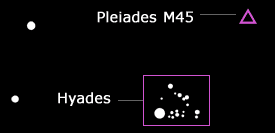
The Hyades are three times closer to the Sun than are the Pleiades [Muirden, p136]. Aldebaran is not a true member of the Hyades cluster, only a foreground star. The Hyades are twice as remote from us as Aldebaran [Moore, Stargazing, p48]. The V pattern of the Hyades is around 9 light years across [Crossen, p 60]. The Hyades may well share a common origin with Praesepe M44 [15].
Double star Theta has a nice color contrast when viewed in binoculars - Theta 1 is orange and Theta 2 is snow-white. [Crossen, p60]. Moore states that Theta can even be split with the naked eye [Moore, Stargazing, p48]. The two Theta stars are not a true double, the white star is 15 light-years closer to us than its "companion" [Moore, Binoculars, p136]

Pleiades
The main cluster is around 7 light years across [Crossen, p60]. "Because of the wide extent of the cluster, binoculars will give a more satisfactory view than can a more powerful instrument of restricted field" [Muirden, p136].
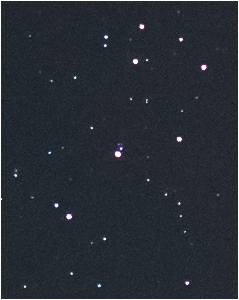
Above: Photograph of Pleiades taken on the evening of the 10th October 2022
Below: Galileo's 1610 telescopic drawing of the Pleiades

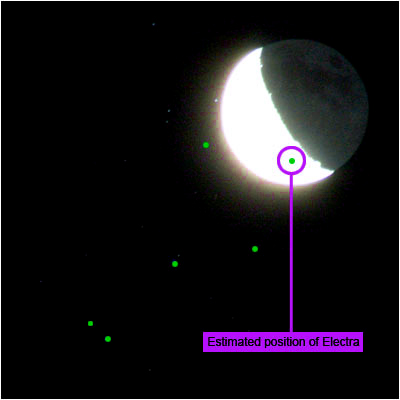
Below: Photographic chart showing Pleiades and the moon early on the morning of the 7th August 2007
Crab Nebula M1
Bright enough to be visible in 35mm binoculars [Crossen, p61].
The Ruby Star (119 or CE Tauri)
One of the reddest stars lying around 1800 light-years away, not a carbon star, more akin to Betelgeuse [11].

|
Footnotes [1] “Science/Nature | ‘oldest Star Chart’ Found.” BBC News, BBC, 21 Jan. 2003, news.bbc.co.uk/1/hi/sci/tech/2679675.stm. [2] Bauval, Robert G. A MASTER-PLAN FOR THE THREE PYRAMIDS OF GIZA BASED ON THE CONFIGURATION OF THE THREE STARS OF THE BELT OF ORION, Discussions in Egyptology 13, 1989, gizamedia.rc.fas.harvard.edu/documents/bauval_de_13_1989.pdf. [3] Colour Evolution of Betelgeuse and Antares over Two Millennia, Derived from Historical Records, as a New Constraint on Mass and Age | Monthly Notices of the Royal Astronomical Society, 29 July 2022| Oxford Academic, academic.oup.com/mnras/article/516/1/693/6651563. Accessed 1 Feb. 2026. [4] “NASA Hubble Helps Detect ‘wake’ of Betelgeuse’s Elusive Companion Star - Nasa Science.” NASA, NASA, 6 Jan. 2026, science.nasa.gov/missions/hubble/nasa-hubble-helps-detect-wake-of-betelgeuses-elusive-companion-star/. [5] Pearson, Ezzy. “Astronomers Have Discovered What Caused Betelgeuse’s Dimming in 2019.” BBC Sky at Night Magazine, 10 Oct. 2022, www.skyatnightmagazine.com/news/betelgeuse-dimming-explained. [6] Towrie, Sigurd. “On Earth as It Is in Heaven – Was Orion Linked to Orkney’s Neolithic Heartland?” Frontiers Magazine, 4 Feb. 2025, frontiersmagazine.org/on-earth-as-it-is-in-heaven-was-orion-linked-to-orkneys-neolithic-heartland/. [7] Howell, Elizabeth. “Rigel: Orion’s Brightest Star.” Space, Space, 18 Mar. 2019, www.space.com/22872-rigel.html. [8] “Messier 42 (the Orion Nebula) - NASA Science.” NASA, NASA, 25 Apr. 2025, science.nasa.gov/mission/hubble/science/explore-the-night-sky/hubble-messier-catalog/messier-42/. [9] “Sci/Tech | Ice Age Star Map Discovered.” BBC News, BBC, 9 Aug. 2000, news.bbc.co.uk/1/hi/sci/tech/871930.stm. [10] Lawrence, Pete. “A Guide to Kemble’s Cascade.” BBC Sky at Night Magazine, 18 Aug. 2025, www.skyatnightmagazine.com/astrophotography/stars/kembles-cascade-asterism. [11] https://www.star-facts.com/ruby-star-119-tauri/ [12] https://explainingscience.org/2024/06/09/sirius/ [13] https://www.skyatnightmagazine.com/space-science/earth-danger-betelgeuse-supernova [14] https://phys.org/news/2025-03-betelgeuse-supernova.html [15] http://www.messier.seds.org/xtra/ngc/hyades.html |